Manufacturing Automation Ideas to Reduce Costs in Canadian Facilities
Cost pressure in Canadian manufacturing rarely comes from a single source. It arrives in layers: labour shortages in one department, rising hydro bills in another, scrap creeping up on a legacy line, and delivery penalties when a machine goes down on a Friday night. The plants that improve margins are usually not the ones chasing the flashiest technology. They are the ones that make a series of practical automation decisions, each tied to a measurable operating problem.
That is the right frame for manufacturing automation in Canada. Not as a capital project for its own sake, and not as a marketing phrase, but as an operating discipline. The best automation investments reduce labour strain, increase machine availability, stabilize quality, and give supervisors better information fast enough to act on it. If those four things happen together, cost reduction follows.
Canadian facilities have a few realities that shape the business case. Wages are high relative to many offshore markets. Skilled trades are hard to recruit in places far from major urban centres. Utility costs vary sharply by province. Winter affects maintenance schedules, shipping reliability, and compressed air systems more than many executives expect. Facilities serving food, wood products, mining, aerospace, automotive, or packaging all face different compliance and uptime demands. Good factory automation respects those differences.
Start where waste is already visible
The quickest way to overpay for automation is to apply it to a process no one has properly measured. I have seen facilities install new automation systems on a line because operators complained about speed, only to discover that the real bottleneck was material presentation upstream. The expensive machine ran beautifully and still missed throughput targets because pallets arrived inconsistently and changeovers remained chaotic.
A better first step is simple observation backed by basic data. Walk the line with production, maintenance, and quality together. Watch one full shift if possible. Look for stops under five minutes, not just major breakdowns. Short stoppages often add up to more lost capacity than a dramatic failure. Notice how operators move. If one person repeatedly crosses the same aisle for labels, parts, or tools, there is probably an automation or layout opportunity hiding in plain sight.
In industrial automation Canada projects, the highest-return opportunities often come from these unglamorous frictions. A plant may not need a full robotic cell. It may need automatic part feeding, machine tending, barcode verification, or a conveyor logic upgrade that prevents minor jams from cascading into half-hour disruptions.
Replace repetitive manual handling before you automate everything else
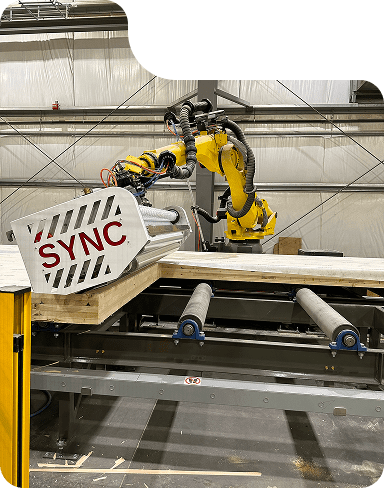
Labour-intensive material handling is still one of the clearest cost targets in Canadian plants. Pick-and-place work, case packing, palletizing, depalletizing, tote transfers, and machine loading create direct labour cost, but they also create indirect costs through fatigue, absenteeism, inconsistent cycle time, and safety incidents.
The reason this area works so well for automation is that the tasks are visible, measurable, and often stable. If an operator lifts the same 8-kilogram component 900 times in a shift, the case for a robot or collaborative robot is not theoretical. It is arithmetic.
That said, not every handling application should go straight to robotics. Pneumatic gantries, servo slides, vacuum lifts, and well-designed conveyors can solve the problem at a lower capital cost and with simpler maintenance. One Ontario manufacturer I visited was preparing a six-figure robotic proposal for carton transfer between two stations. After a few hours on the floor, the simpler answer emerged: a reoriented conveyor, a timing gate, and a low-cost reject diverter. The change reduced labour by one person per shift and removed a recurring source of box damage. It was not glamorous, but the payback was under a year.
Where robotics do make sense, the hidden success factor is upstream consistency. Grippers, vision systems, and robot paths can handle variation, but only within reason. If incoming parts vary wildly, fixtures are worn, or pallets are positioned manually with poor repeatability, the robot will inherit the chaos.
Attack downtime with sensors and simple condition monitoring
A surprising amount of downtime begins as a small mechanical or electrical problem that no one noticed early enough. Bearing heat rises. Air pressure drifts. A motor draws slightly more current. A gearbox vibrates a little harder each week. https://mylesqwmm241.bearsfanteamshop.com/end-of-arm-tooling-innovations-driving-flexible-manufacturing-automation In plants with thin maintenance coverage, those signals go unseen until the line stops.
This is where practical industrial automation solutions can outperform more ambitious digital programs. You do not need a massive analytics platform to save money. In many facilities, a modest layer of condition monitoring tied into the existing PLC or SCADA environment pays for itself quickly. Temperature sensors on critical bearings, current monitoring on conveyors and pumps, pressure switches on pneumatic circuits, and runtime counters on wear components can prevent expensive failures.
The key is selecting assets that justify attention. A noncritical exhaust fan does not need elaborate monitoring if failure causes little disruption. A filler, main compressor, paint booth conveyor, or primary packaging line usually does. Canadian facilities with older equipment can benefit especially here because legacy machines often run well but lack visibility. A retrofit of low-cost sensors and alarm logic can extend useful life without the cost of full replacement.
Supervisors should also be careful with alarm volume. If every fluctuation generates an alert, operators will ignore all of them. Good automation systems distinguish between an informational event, a warning, and a stop condition. That judgment matters more than the sensor count.
Reduce energy costs where controls can actually influence consumption
Energy reduction is an easy promise and a difficult reality unless the engineering team understands where electricity, gas, compressed air, and water are truly being used. In Canadian manufacturing, energy economics differ by province and by tariff structure, but one truth is widespread: compressed air leaks, uncontrolled motor operation, and poor scheduling quietly drain margin.
Variable frequency drives are often a good place to look, though not universally. Fans, pumps, and certain conveyors respond well when speed can be matched to demand. Installing drives on systems that only ever need to run at one constant rate can add complexity without meaningful savings. Experience matters here. Controls should support the process, not burden it.
Compressed air deserves special attention. Plants frequently treat it as free because the cost is hidden at the utility room. It is anything but free. Automated leak detection routines, pressure monitoring by zone, and machine logic that closes air to idle circuits can reduce waste. In winter, when facilities are sealed tightly and compressors work harder, those savings are often more visible on the monthly bill.

Energy dashboards can help, but only if they are specific enough to drive action. A plant-level energy number is useful for finance and sustainability reporting. It is not very helpful to a maintenance lead trying to understand why Line 4 suddenly consumes more power per unit than it did last month. Submetering critical processes brings accountability down to the line level, where improvements actually happen.
Build quality into the process instead of inspecting defects afterward
Many plants still rely too heavily on end-of-line inspection. That approach catches some problems, but it does not remove the cost of rework, scrap, missed shipments, or operator time spent sorting bad product from good. Better manufacturing automation pushes quality checks into the process itself.
Vision inspection is the obvious example, especially for label verification, part presence, orientation, print readability, seal integrity, or surface defect detection. But there are simpler methods too. Torque confirmation on screwdriving systems, recipe interlocks that prevent the wrong material from being loaded, poka-yoke sensors on fixtures, and automatic gauge feedback to the machine all reduce quality cost before defects multiply.
A food processor in Western Canada once struggled with intermittent coding errors on packaged product. Manual checks were inconsistent, and the issue only surfaced after pallets had already been wrapped. The solution was not a large new line. It was a code verification camera, a reject mechanism, and revised line logic that forced operator acknowledgment after repeated faults. Scrap fell, customer complaints dropped, and shift leads finally had real-time visibility into when the problem occurred.
That is an important lesson. Good factory automation does not just reject bad parts. It creates traceability around when, where, and why a defect appears. Without that context, recurring quality losses become folklore instead of engineering problems.
Modernize changeovers, because setup time is usually undercounted
Many managers track runtime and downtime closely but treat changeover as unavoidable overhead. That misses one of the richest automation opportunities in mixed-product facilities. Shorter, more repeatable changeovers free up productive time without running equipment harder.
Recipe management through the HMI is one strong lever. Servo-driven adjustments, stored position parameters, and guided setup prompts reduce trial-and-error at startup. If an operator currently relies on handwritten notes and physical rulers to reset guides and tooling, the line is paying for variation every time a SKU changes.
The savings show up in several places. Labour drops because setup takes fewer hands and fewer minutes. Scrap falls because first-off quality stabilizes faster. Planning gets easier because short production runs become less painful, which matters for Canadian plants serving diverse domestic customers with moderate batch sizes rather than huge single-SKU volumes.
There is a trade-off, though. Recipe-driven systems need disciplined governance. If unauthorized edits proliferate or version control is weak, setup becomes digital chaos instead of mechanical chaos. Access levels, backup practices, and change logging matter.
Use production data that operators trust
The conversation around data in manufacturing often jumps too quickly to enterprise dashboards. The more urgent question is whether people on the floor trust the numbers. If operators, maintenance, and production planning all argue about downtime reasons or unit counts, any cost-reduction effort will stall.
That is why line-level data collection should start with a few metrics that directly affect decision-making. Uptime, cycle time, scrap rate, micro-stoppages, and changeover duration are usually enough to expose meaningful losses. In well-run automation systems, those values are captured automatically where possible, with manual reason codes used sparingly and defined clearly.
The design of the interface matters. If entering a downtime reason takes eight screen presses, people will pick the first available code just to get the line moving. If the categories are vague, the data becomes politically convenient and operationally useless. A practical system gives operators quick, accurate choices and lets engineering refine categories over time.
Here are the metrics I would prioritize first in a cost-focused automation upgrade:
- Unplanned downtime by asset and cause
- Scrap and rework by product family and shift
- Actual cycle time versus standard cycle time
- Changeover duration, including first-good-part time
- Labour hours per unit on the targeted line
This kind of visibility is where industrial automation Canada projects often start to compound. Once a line has trustworthy data, the next improvement becomes easier to justify. Teams stop debating whether a problem is real and start debating how best to solve it.
Retrofit older equipment before assuming replacement is necessary
Canadian plants often run a mix of machine vintages. It is common to find a robust piece of equipment from the 1990s beside a recently installed servo line. The older machine may still perform its core task very well. What it lacks is often control flexibility, diagnostics, spare parts availability, or communication capability.
A thoughtful retrofit can bridge that gap. Replacing obsolete drives, upgrading PLCs, adding HMIs, improving guarding interlocks, and integrating sensors can turn a frustrating legacy asset into a manageable one. This is especially attractive when the machine frame and process mechanics remain sound. Full replacement may still be the right move if throughput needs have changed dramatically or maintenance costs are spiralling, but too many companies jump there too soon.
Retrofits do carry risk. Documentation may be incomplete. Wiring in old panels can be inconsistent with the drawings. Production teams sometimes underestimate the commissioning period because the machine “already works.” Anyone planning this kind of automation should budget time for discovery, electrical cleanup, and operator retraining. When those realities are acknowledged upfront, retrofit economics can be very strong.
Design for maintenance from the beginning
An automation project that lowers direct labour but raises maintenance headaches is not a cost win. I have seen beautifully engineered cells lose support from the floor because routine tasks became awkward. Sensors were mounted where no one could reach them safely. Spare parts were exotic. Fault messages were cryptic. A fifteen-minute recovery turned into a one-hour guessing exercise.

Maintainability should be part of the original specification. Components should be accessible. Faults should be described in plain language on the HMI. Standardization matters, particularly across multi-site Canadian operations. If every line uses a different family of drives, terminals, and I/O hardware, inventory cost rises and troubleshooting slows.
A short checklist helps during design reviews:
- Can maintenance access common wear parts without dismantling half the machine?
- Are fault messages clear enough for first-response diagnosis on the floor?
- Do key components align with existing site standards and spare inventories?
- Is remote access secure, controlled, and genuinely useful for support?
- Have operators been included in the review of jam clearance and restart logic?
These are not glamorous questions, but they separate durable factory automation from expensive frustration.
Use automation to ease the labour shortage, not just remove heads
In many Canadian regions, the problem is not simply labour cost. It is labour availability. Plants struggle to staff night shifts, repetitive stations, and physically demanding jobs. Automation changes the labour equation, but the best facilities do not treat it as a blunt replacement strategy. They use it to redeploy people toward work that improves flow, quality, and uptime.
For example, automating palletizing may allow an operator to move into line oversight, materials coordination, or basic quality verification. Automating repetitive screwdriving may let a skilled assembler handle more value-added steps. This matters because automation projects succeed faster when the organization sees them as relief from chronic staffing pressure rather than a threat to every role.
Training is part of the cost picture too. A plant that installs new automation systems without upgrading operator and technician capability will stay dependent on outside integrators. There is nothing wrong with using external support, but the operating model becomes expensive if every sensor replacement or recipe edit requires a service call. Basic in-house ownership reduces cost over the life of the system.
Where Canadian plants often misjudge ROI
Payback calculations usually focus on direct labour savings because they are easy to quantify. That is useful, but incomplete. In practice, many projects earn their return through a combination of smaller gains: less scrap, fewer injuries, lower overtime, reduced contractor callouts, tighter scheduling, and better customer performance. Each item may seem modest on its own. Together, they can outweigh the labour line entirely.
Plants also tend to understate integration effort. Electrical upgrades, guarding changes, floor space constraints, and ERP or MES connections can add time and cost. So can utility readiness. A robotic cell may require compressed air quality improvements, floor reinforcement, or network segmentation that no one captured in the first budget meeting.
The strongest business cases are honest about these extras. They include commissioning time, training, spare parts, and post-startup tuning. They also acknowledge seasonal production realities. A facility with intense demand peaks may place more value on uptime and schedule stability than on unit labour reduction alone. In that case, a project with a slightly longer paper payback may still be strategically smarter.
A practical path forward
Plants do not need to automate everything to reduce costs meaningfully. They need to automate where loss is frequent, measurable, and expensive. For one facility, that will mean robotic material handling. For another, it will mean retrofitting a dependable but opaque machine with modern controls. For another, it will mean production data that finally exposes the true source of lost capacity.
The common thread across successful manufacturing automation projects is discipline. The team defines the operating problem clearly, chooses the simplest automation that can solve it reliably, and designs for maintainability from day one. They measure results after startup, not just during the capital request. They stay grounded in plant reality.
That approach is especially well suited to Canadian manufacturing. It respects high labour costs, scarce technical talent, mixed-vintage assets, and the constant need to do more with the footprint and headcount already in place. When industrial automation solutions are selected that way, cost reduction is not a slogan. It shows up in fewer stoppages, steadier output, lower waste, and a plant floor that runs with less strain every shift.
Sync Robotics Inc. — Business Info (NAP)
Name: Sync Robotics Inc.Address: 2-683 Dease Rd, Kelowna, BC V1X 4A4
Phone: +1-250-753-7161
Website: https://www.syncrobotics.ca/
Email: [email protected]
Sales Email: [email protected]
Hours:
Monday: 8:00 AM – 4:30 PM
Tuesday: 8:00 AM – 4:30 PM
Wednesday: 8:00 AM – 4:30 PM
Thursday: 8:00 AM – 4:30 PM
Friday: 8:00 AM – 4:30 PM
Saturday: Closed
Sunday: Closed
Service Area: Kelowna, British Columbia and across Canada
Open-location code (Plus Code): VHWR+PQ Kelowna, British Columbia
Map/listing URL: https://maps.app.goo.gl/xwtV2wEu8ZuKH3se8
Embed iframe:
Socials (canonical https URLs):
LinkedIn: https://www.linkedin.com/company/syncrobotics/
Instagram: https://www.instagram.com/syncrobotics/
Facebook: https://www.facebook.com/syncrobotics/
https://www.syncrobotics.ca/
Sync Robotics Inc. is an industrial robot and controls integration company based in Kelowna, British Columbia.
The company designs and deploys automation solutions for manufacturing operations across Canada.
Services include industrial robotics integration, controls integration, automation system design, deployment support, and related manufacturing automation solutions.
Sync Robotics Inc. is located at 2-683 Dease Rd, Kelowna, BC V1X 4A4.
To contact Sync Robotics Inc., call +1-250-753-7161 or email [email protected].
For sales inquiries, email [email protected].
Hours listed are Monday to Friday 8:00 AM–4:30 PM, with Saturday and Sunday closed.
For directions and listing details, use the map listing: https://maps.app.goo.gl/xwtV2wEu8ZuKH3se8
Popular Questions About Sync Robotics Inc.
What does Sync Robotics Inc. do?Sync Robotics Inc. designs and deploys industrial robot and controls integration solutions for manufacturing operations.
Where is Sync Robotics Inc. located?
Sync Robotics Inc. is located at 2-683 Dease Rd, Kelowna, BC V1X 4A4.
Does Sync Robotics Inc. serve clients outside Kelowna?
Yes—Sync Robotics Inc. is based in Kelowna, British Columbia and serves clients across Canada.
What are Sync Robotics Inc.’s hours?
Monday–Friday: 8:00 AM–4:30 PM; Saturday and Sunday closed.
How can I contact Sync Robotics Inc.?
Phone: +1-250-753-7161
General Email: [email protected]
Sales Email: [email protected]
Website: https://www.syncrobotics.ca/
Map: https://maps.app.goo.gl/xwtV2wEu8ZuKH3se8
LinkedIn: https://www.linkedin.com/company/syncrobotics/
Instagram: https://www.instagram.com/syncrobotics/
Facebook: https://www.facebook.com/syncrobotics/
Landmarks Near Kelowna, BC
1) Kelowna International Airport2) UBC Okanagan
3) Rutland
4) Orchard Park Shopping Centre
5) Mission Creek Regional Park
6) Downtown Kelowna
7) Waterfront Park